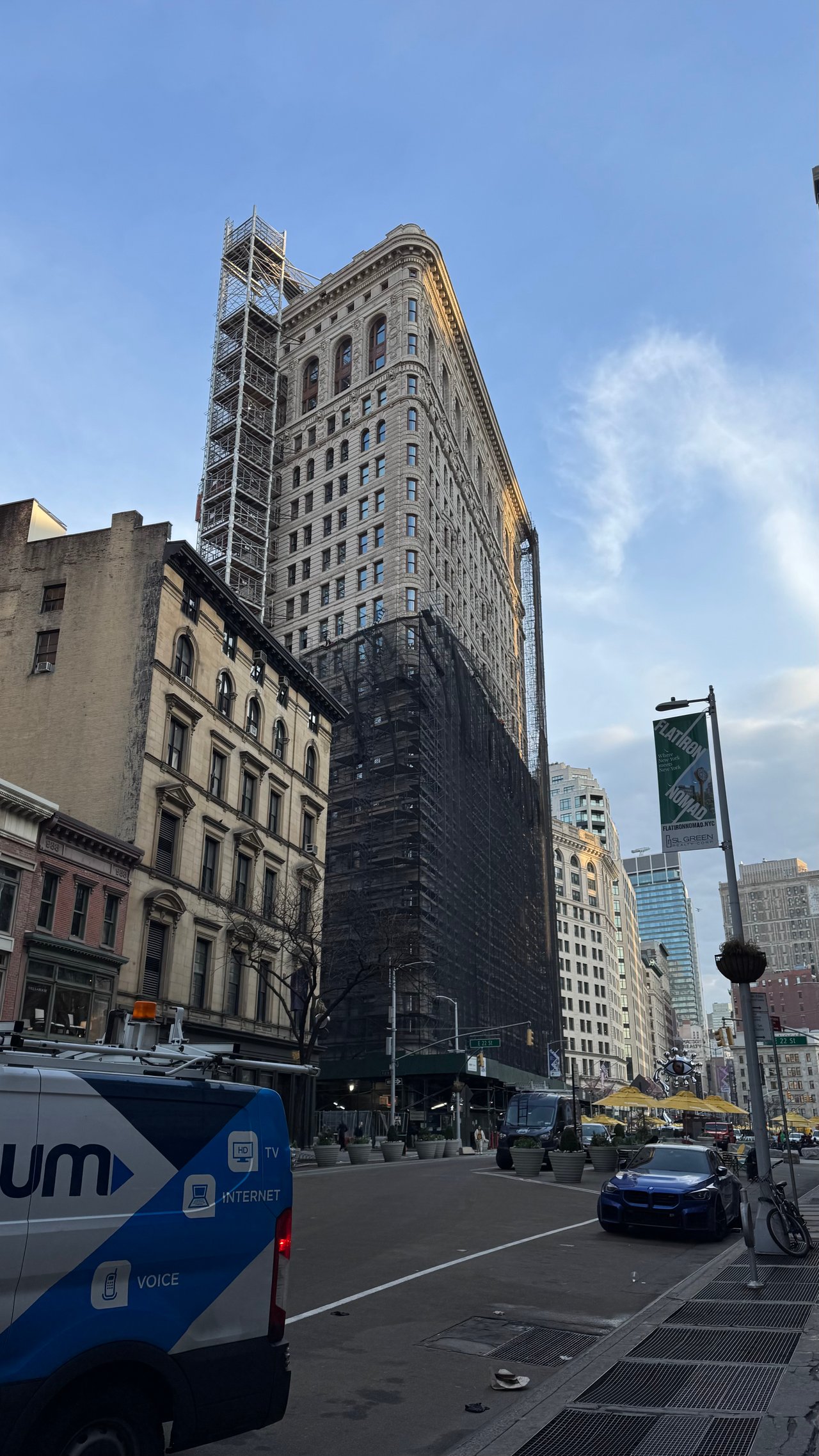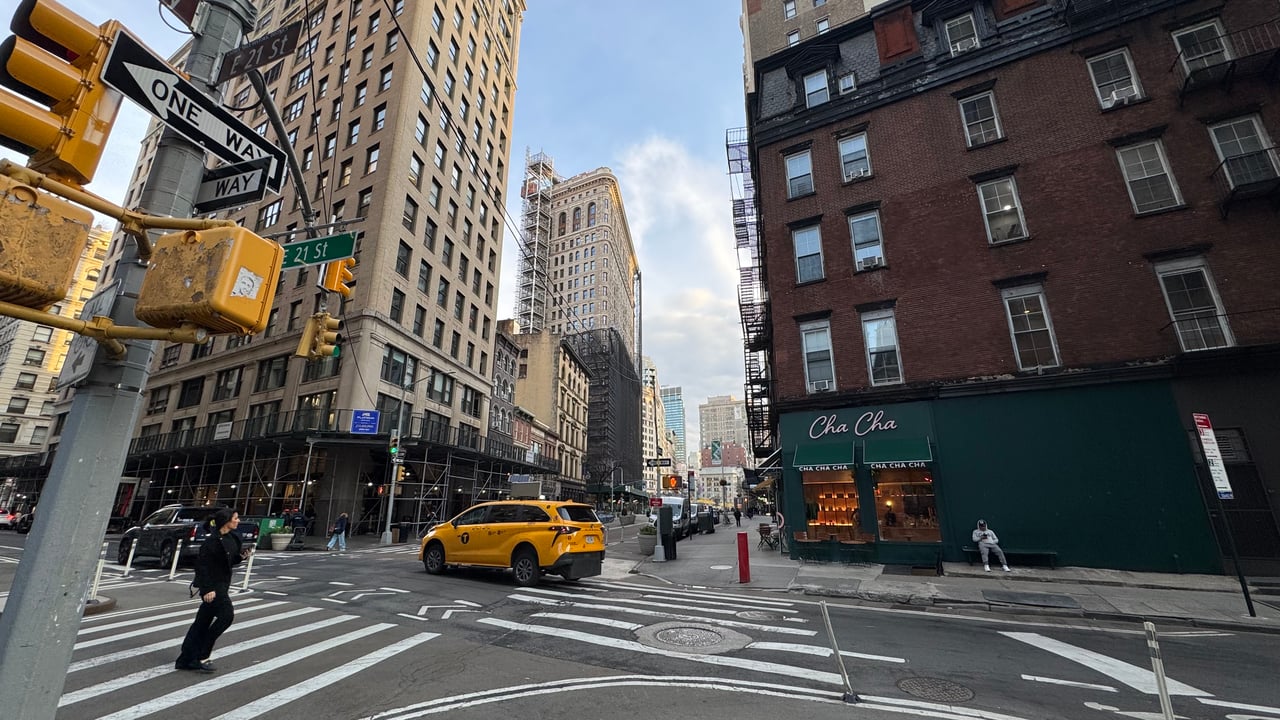
There are certain New York moments that quietly signal change. The return of outdoor dining in the spring. The first warm evening walk down Fifth Avenue. And now — something even more symbolic — the scaffolding is finally coming down from the Flatiron Building.
For years, the black netting and construction wrap have softened the sharp silhouette of one of Manhattan’s most photographed landmarks. Walking past it daily, I’ve felt the absence of its full presence. The Flatiron isn’t just architecture — it’s atmosphere. It anchors the neighborhood, defines the skyline at 23rd Street, and reminds you that New York has always been a city of reinvention.
Now, after years of restoration work, the building is beginning to re-emerge — and with it, a renewed sense of energy in the Flatiron District.
A Landmark Returns
Completed in 1902 and designed by architect Daniel Burnham, the Flatiron Building quickly became one of the most recognizable structures in the world thanks to its distinctive triangular shape at the intersection of Broadway, Fifth Avenue, and 23rd Street.
Even in a city defined by iconic architecture, the Flatiron holds a special place. It’s one of those buildings that feels cinematic — almost like it belongs equally to history and the present. Whether photographed in black and white or framed in golden-hour light, its presence is unmistakable.
For the past several years, however, the building has been undergoing an extensive restoration and conversion process. After sitting largely vacant since 2019, plans were approved to transform the property into luxury residential condominiums, ushering in a new chapter for the historic structure.
The renovation includes facade restoration, window replacement, upgraded building systems, and a thoughtful modernization designed to preserve the landmark’s historic integrity while adapting it for contemporary living.
If you live or spend time in Flatiron, you know how long the scaffolding has been part of the streetscape. It became almost normal — a reminder that even icons need maintenance.
But scaffolding, especially in New York, often signals transition. It means something is evolving.
Former Mayor Eric Adams’ broader initiative to remove long-standing sidewalk sheds across the city reflects a growing desire to restore architectural beauty and improve the pedestrian experience.
And when the scaffolding comes down on a building as symbolic as the Flatiron, it feels bigger than construction progress — it feels like the neighborhood is being reintroduced to itself.
Why This Matters for the Neighborhood
As someone who walks past the Flatiron Building nearly every day, I’ve watched the subtle shifts in the area — new retail concepts, evolving office demand, and increasing interest in residential conversions.
The transformation of historic office buildings into residential spaces reflects a broader trend shaping Manhattan’s future. Adaptive reuse projects like this not only preserve architectural heritage but also help meet the ongoing demand for housing in prime neighborhoods.
The Flatiron’s conversion signals continued confidence in Manhattan real estate, particularly in neighborhoods that combine history, transit access, and lifestyle appeal.
In other words: the story of the Flatiron is also the story of New York real estate — resilient, adaptive, and always moving forward.
When you walk past the Flatiron every day, you start to notice how people interact with it.
Tourists pause mid-intersection to capture the perfect photo.
Locals glance up, almost subconsciously, as they pass.
Even lifelong New Yorkers still acknowledge its presence.
Seeing it gradually uncovered feels like reconnecting with an old friend.
And for those of us who consider Flatiron part of our daily rhythm — our neighborhood, our “hood” — it’s exciting to watch this next chapter unfold in real time.
Because in New York, even the most historic buildings are never finished telling their story.
Thinking about buying, selling, or investing in Flatiron, NoMad, or Gramercy?
This isn’t just a market I study — it’s the neighborhood I live, walk, and experience every day. From iconic buildings like the Flatiron to discreet off-market opportunities, I help my clients understand not just the numbers, but the story behind the block.
If you’re considering your next move in Manhattan, let’s talk.
Joseph Lecz Real Estate, On Your Side.